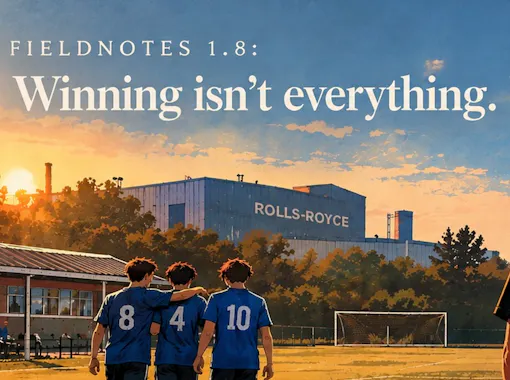

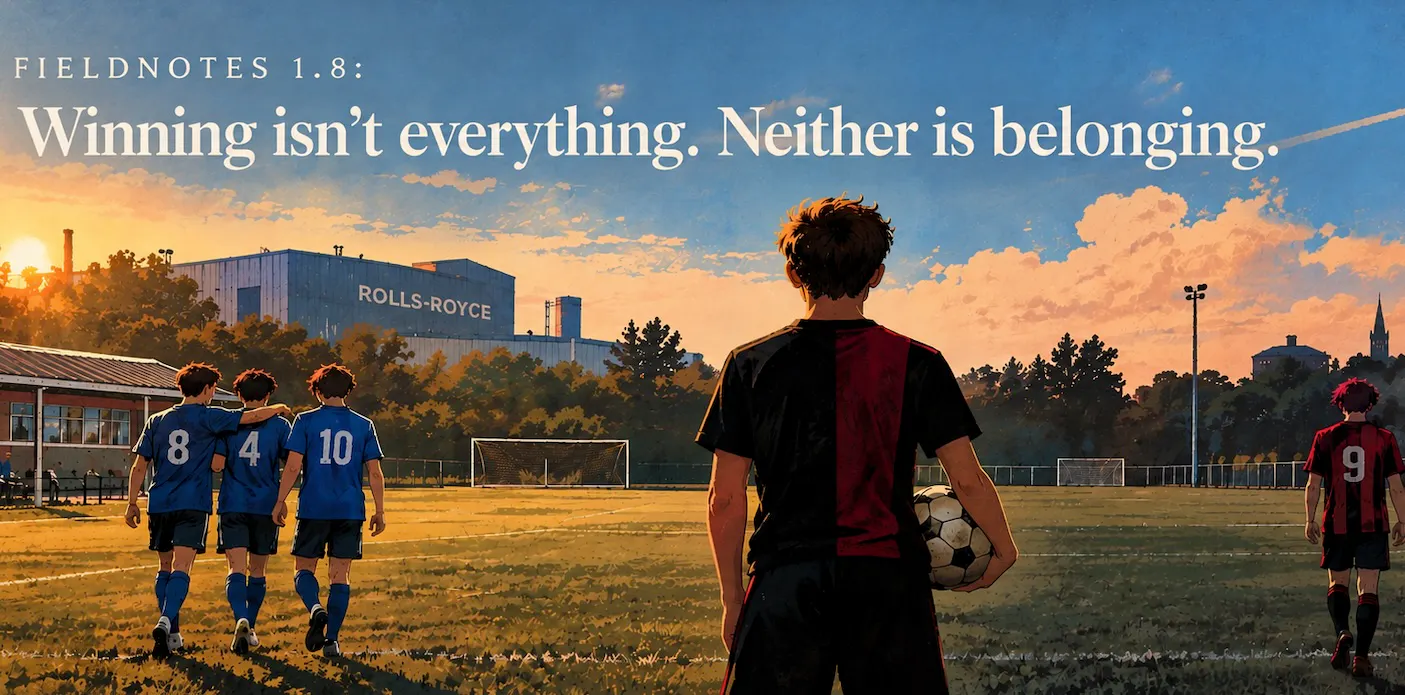
fieldnotes 1.8: Winning isn’t everything. Neither is belonging.
This is a different kind of fieldnotes1.0.
For a start, it’s about a team I was part of, rather than one I’ve worked with.
Actually, it’s about two teams I was part of, a long time ago now, and the reflections I’ve had in the years since.
It's also longer - so to spare your inbox here's Part 1. We'll be back with the 'Shift' in November.
Prologue
I was an OK footballer.
From 14 to 16, I played for a local team: Hucknall Rolls-Royce, named after the owners of the land and facilities we rented to play on.
‘Rolls’, as we called both the team and the venue, was about 2.5 miles from my house. I could cycle there for training and, on summer days, my close friends (who also played for the team) and I would walk up via the country trails that skirted the dual carriageway.
On Saturdays, if we were lucky, we’d hear the Merlin engines being tested in the nearby factories. The story was that they’d test them by firing frozen chickens into the engines. Please someone fact check this…
After matches, we’d all stay behind in the clubhouse. We’d watch the Premier League scores come in, the parents all knew each other and we’d often extend our time together into the early evening.
I guess you’d call this community. Looking back, there was a real sense of it.
I loved my time at Rolls.
But here’s the kicker.
We were rubbish. I mean terrible.
My memories of the matches themselves are not particularly fond. We took heavy losses and had to fight and scramble for every point to avoid relegation.
And yet, this seemed to bond us even closer as a group.
At the end of my Under-16s season, I had a choice to make. Stay at Rolls and shoot for a place in the Men’s team, or go elsewhere.
I put the decision off until the last possible minute.
And so it was that we arrived at the final game of the season, lining up against the famed red and black stripes of West Bridgford Colts. The best team in the league, across pretty much every age group, and had been for what seemed like forever.
We’d survived relegation. They’d already won the league. Neither team had anything to play for.
But I played great.
Maybe liberated by a sense of freedom. Maybe driven by a desire to stick it to the league’s best. Whatever it was, I put in a Man of the Match performance.
As I’m trudging off the pitch at the end, knowing I have a decision to make about where I’ll play next season, I get the literal tap on the shoulder.
The opposition manager pays me some very nice compliments and invites me to pre-season training with Colts.
I’m blown away. Flattered. I say yes on the spot.
Turning up at their training pitches for the first time was nerve-wracking. I didn’t know anyone, but I was determined to make it work.
In no small part because their pitches were a stone’s throw from Nottingham Forest’s Football Academy, where my brother (a much better footballer) was already playing.
Never underestimate the power of sibling rivalry.
Pre-season went well.
I was invited to join the team, which meant having a difficult conversation with my friends about leaving Rolls.
I was sad to say goodbye but, naively, I thought: this might be my chance.
The next season was a success.
We won the vast majority of our matches. That felt weird.
I did pretty well too, despite having to adapt to playing in a position I wasn’t used to (but which ultimately suited me better, something I didn’t want to admit at the time).
We won the league. I’d never experienced that before.
We won the cup. And I scored in the final.
It was also my last game.
I hated my season there.
Despite the turnaround in results, the trophies and frankly becoming a better player, I didn’t enjoy my season in the red and black.
I’d lost that sense of community.
There were cliques in the team that I couldn’t break into. I was from a different part of town. Our parents didn’t know each other. We didn’t go to the same schools or hang out in the same places.
And the manager criticised every win.
We’d get back into the changing room after winning 5-0 and, amongst the mud, the stench of Deep Heat and cut-up oranges, there’d be a red mist hanging over everything that hadn’t worked.
Positional tweaks. Individual errors. Someone’s shirt not being tucked in (yes, that used to be a thing).
There was always something wrong.
In short, I’d lost the things I liked most about Rolls.
I thought a lot about whether I’d made the right choice and, for a long time, convinced myself I’d been wrong to leave my friends.
But in the years that followed, I came to realise something.
Neither team had got it right.
Field notes
At Rolls, I had everything I wanted from the experience of being part of a team.
Friendships, belonging, camaraderie. People I cared about and who cared about me.
But we couldn’t win a game.
At Colts, I had everything I thought I wanted from the experience of playing football.
Success, recognition, development. The chance to test myself against better players and win things.
But I couldn’t wait for the season to end.
Neither was enough.
And this is something I see in the teams I work with today.
We often talk about culture and performance as though they’re competing priorities.
Some teams pride themselves on their culture. They get along, look after each other and genuinely enjoy being together. But beneath the surface, there can be a reluctance to challenge, hold each other accountable or confront underperformance.
Other teams pride themselves on their results. They’re ambitious, demanding and relentlessly focused on delivery. But the experience of being part of the team can be exhausting. Relationships become transactional, trust is thin and success rarely feels like something worth celebrating.
Both can convince themselves they’re doing well.
And both are missing something.
I think part of the problem is that we imagine culture and performance sitting at opposite ends of a scale.
At one end, the warm, friendly team where everyone gets along.
At the other, the hard-driving, high-performing team where results are everything.
And we assume the answer is somewhere in the middle.
A little less comfort. A little less pressure. Some kind of compromise.
But I don’t think that’s right.
Culture and performance aren’t opposite ends of the same scale. They’re two different dimensions.
A team can have a great culture and perform poorly.
It can perform brilliantly while being a miserable place to work.
It can be poor at both.
Or it can be exceptional at both.
That’s the space I’m interested in.
The teams where people feel a deep sense of belonging and a responsibility to deliver.
Where people care enough about each other to have difficult conversations.
Where high standards aren’t something imposed by a demanding leader, but something the team collectively owns.
Where success feels good because of who you’ve achieved it with.
The important distinction, I think, is that a great culture isn’t necessarily a comfortable one.
And high performance doesn’t have to come at the expense of the people delivering it.
In fact, I increasingly believe the two should reinforce each other.
When people feel connected to a team, they have something worth working hard for. When they’re challenged to improve and achieve something meaningful together, that shared experience can deepen their connection.
Of course, neither happens automatically.
A friendly team doesn’t become high-performing simply because everyone likes each other.
And a successful team doesn’t develop a healthy culture just because it keeps winning.
Both require attention.
Watch out for the lessons I've drawn from this in Part 2 next month.